In my previous post about reading a book halfway through, I mentioned how I would move on to the next book before finishing the one I had started. But weeks or months after putting that book down, I’d finally return to it, discovering it anew like a forgotten story I had once read.
At first, it’s like being flung into a scene where the characters are in a heated debate. You know not what’s going on, but you can’t help but finish the chapter given how tense it is. And as you turn the pages, the characters from chapter 1, 2, etc., slowly return to mind, and all the details and plot elements begin to take shape as you reconnect all the dots.
It’s kind of like reading a short story, even if you’re at the middle of the book you took a break from. For a short story can drop you in the middle of the action/scene, and as you read, you slowly catch up (and see) what’s going on.
As the book ultimately reaches its conclusion, it’s too late to put the book down and read something else. With the end in sight, to stop and read something else now would spoil the impact of the last pages. Besides, wouldn’t you want to know what happened at the end?
Sometimes I’ll read a book halfway through before moving on to the next. For some reason, after the halfway point, it’s difficult for me to progress and finish a story. Whereas in the first half of the book, I could easily read 20 pages or more in a single sitting, after the halfway point, I might read 5 pages at a time.
Then I’ll start another book, and the process will begin all over again. I’m not sure what it is about the halfway point where I feel like I’ve reached the end when I’m only halfway through. Part of it is that my focus (and interest) will begin to wane, and given how many other books I want to read, my focus will drift to the others.
Some of the stories I’ve finished have felt like a marathon. It’s like a push (or race) to the finish line, where I know I’m almost at the end, but I have to mentally tell myself to keep going. It’s one of those things where I just have to tell myself “just a few more pages,” and say it on repeat. If I do it enough times, I’ll make it to the end.
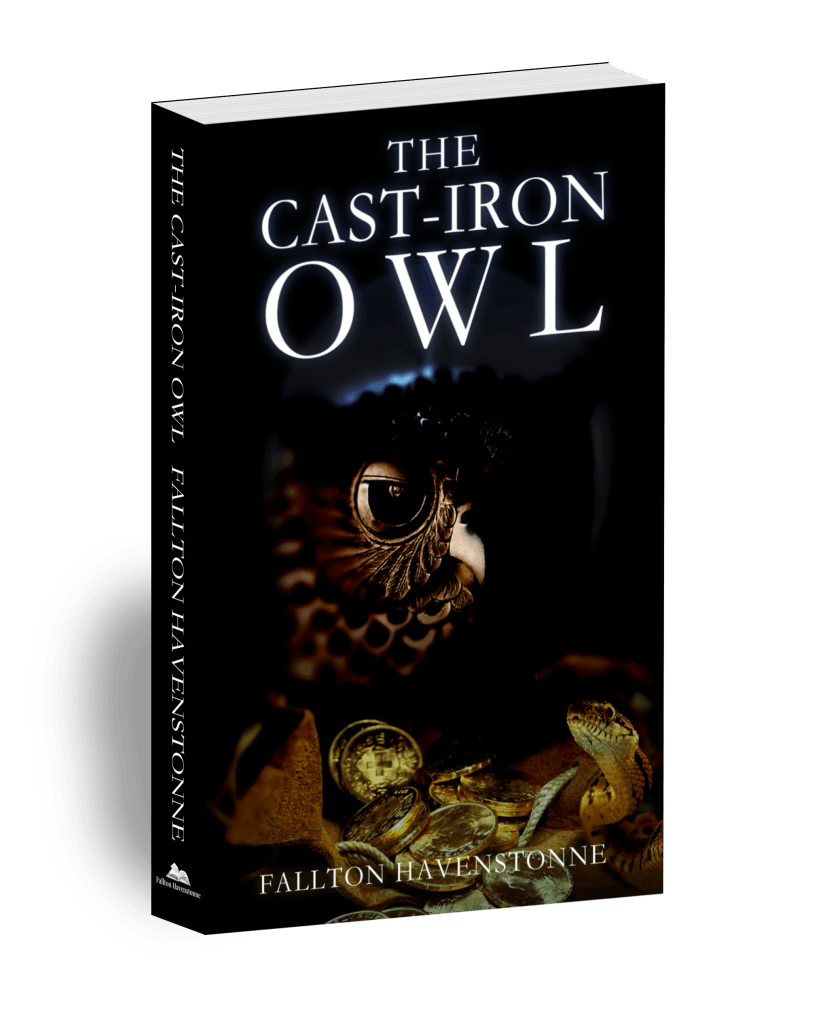
I’m excited to share the release of my newest novel: The Cast-Iron Owl.
Click the book cover to watch the book trailer (on YouTube) for the novel.
The Story
The Cast-Iron Owl is a supernatural thriller about a mother and daughter who find an antique cast-iron owl at a thrift shop. The daughter, Mary, can hear a bell-like sound emanating from it, and she begs her mother, Jane, to buy it. Jane is reluctant since she thinks it’s overpriced, but soon, they will discover that there is something ominous within the cast-iron owl that will change the course of their lives.
Book Cover Design Process
It took several iterations to create the final book cover that you see above. What’s interesting is that at each step of the process, I felt satisfied with the result I had, only to feel like I had to continue modifying it since it seemed inadequate. The process to arriving at the final book cover was a gradual one–one that was the result of countless adjustments and meticulous changes that led to a design where I felt that any additional changes was no longer necessary. Or to put it another way: any additional changes would only lead me to undo them.
Writing the Story
The idea for the story occurred to me over a year ago. It’s one of those concepts where one thing happens that leads to a chain of events that spiral out of control. It took awhile to work out the premise and concept behind it, although actually writing the story didn’t happen until much later (once I had a clear vision of the story, much like a filmmaker who has a vision of the look of their film).
When I first wrote the story, I wanted it to primarily focus on the point of view of the mother and daughter. However, as I started to edit it, I realized that I needed to tell the story from different points of views to show the impact of the objects on the other characters.
Another thing that required a lot of planning was the sequence of events. Since the events can sometimes overlap on certain days, I had to organize and plan out how one event at one location would affect a character(s) at a different location. It took some time to straighten out all of the details, but in the end, it will read seamlessly as if the events are occurring naturally.
Where to get The Cast-Iron Owl
The novel is available for pre-order on the Kindle, and it will be released on 8-16-23.
I’m in the process of wrapping up my next novel. It’s been a work in progress for several months, and the original idea for it occurred to me over a year ago.
I’ve been working on the cover design for it, and am very happy with how it turned out. I even made a book trailer for the novel, which I will upload at some point. I’m hoping to release the book before the end of summer. It’s a story that has supernatural elements, mixed with crime and mystery.
One inspiration for the novel was the author Edith Wharton. She wrote a collection of short stories about ghosts that left me thinking about apparitions in a different light. She didn’t write about ghosts in the way that they’re portrayed in movies where they jump out of the dark and scare characters. Rather, the ghosts in her stories seem to come and go without notice, leaving the characters with a sense that some entity is there (or had been there). She created an eeriness to the mood and tone of her stories that made the characters’ discovery of the ghosts even more chilling.
So if you’re wondering if there are ghosts in my newest novel, don’t be surprised if there are. It’s a story that transcends this reality, since ghosts are supernatural.
The X-Files was another inspiration for this story, since I like how that show blended science, mystery, and supernaturalism into the episodes. When I wrote this story, I drew influences from all over and brought them together to express my individual ideas and voice in a story that I believe will resonate with the reader.
After spending a full day at work, the remaining time we have left is divided up by tasks and chores. A trip to the grocery store, the bank, the gas station, or any other place that we need to go to before we drive home. It always takes longer than we expect. Not to mention the time it takes to drive to those places, and the time added on to the commute because of traffic. And once we get home, it takes time to make dinner, time to eat it, time to clean it up, and then time to relax, exercise or watch TV.
After all is said and done, is there still time left to read? It takes energy and focus to read. Reading requires having enough time to immerse ourselves into the story, for our imagination to bring the sentences on the pages to life. It can’t be rushed, can’t be skimmed over as if we’re trying to finish up a book report for a literature class. We need to take our time with a book–let the book take shape in our minds.
Busyness can consume us, and make us focus on finishing things rather than enjoying the time we have left before going to bed. Reading, on the other hand, is more about the experience, of letting our imagination take us to another place, another world. When we don’t give ourselves enough time to read, we can lose ourselves in every day tasks and chores, forgetting that there is a world out there beyond every day things.
When I read, I’ll fill in the blanks to make sense of things, and when the text isn’t clear. Without realizing it, we fill in the blanks to connect the dots when the information doesn’t seem to click. With the limited information we’ve gathered from the book, we use inductive reasoning to put things together, to give it cohesiveness and a reality that we can identify with.
But sometimes we might fill in the blanks with the wrong data–the wrong assumptions. I’ve done this many-a-times in which I’ll assume the characters of a story are in a certain environment when they’re not, or that they know each other when they don’t. Or I might assume an event has taken place when it hasn’t yet, or that a character knows a bit of information when they don’t.
Reading often involves self-correcting and getting the information right and consistent to form an understanding of the plot and characters. We naturally bring a bit of ourselves into the story: what we understand of what a word means or what a place or an environment should look like. But we also get tired when we read, so we’re not always one hundred percent focused, which can cause us to miss or forget information that might be relevant later on.
Thus, we have to fill in the blanks to follow the story. If we don’t, we’re not really using our imagination to transform words into images, sounds, and ideas that are unique to us–that have meaning to us.
Whenever I catch errors as I’m reading a book, I’ll be taken aback in surprise. At first, I’ll be in disbelief, and I’ll reread the passage to make sure that I hadn’t misread it or that it was supposed to be a mistake (i.e. if it was part of a character’s dialogue). Once I realize that the error I caught was indeed an error, I’ll start to wonder how many more there are–if I had missed any prior.
I won’t feel disappointed by the error, however. On the contrary, it reinforces the fact that no matter how thoroughly a book has been checked for spelling and grammar, there are errors that are hidden–errors that seem to blend in one with the page, and could only be caught by someone who isn’t familiar with the book–someone who is reading it for the first time.
There’s a saying that during the editing process, we should get another pair of eyes on our draft. For one, the reader can catch the errors we missed due to our blindspots, since we’re so familiar with our work that we don’t see the errors that would stand out for someone else. Also, even if we’ve proofread our work a dozen times, that doesn’t mean that there aren’t errors we had skimmed over or missed. Besides, our knowledge and application of grammar rules, punctuation, and word usage could have flaws.
When chapters are short (i.e. 2 – 5 pages), it’s easy to breeze through them, get to the next chapter without taking a break. On the other hand, when chapters are long, it can get tiring and exhausting to reach the end. For me, I’ll close the book once I start yawning or my eyes get heavy. If I don’t make it to the end of the chapter on the second reading session, I’ll be less inclined to pick up the book for a third session.
And each time I read it and don’t finish a chapter, I’ll read less each time I pick up the book. It’s like I’m not making any headway in the book. When I read a book, I want to feel rewarded by the experience, to learn something new or at least make it to the next check point. And if I’m not at least making it to the next “check points” (i.e. chapters), and it becomes more of a chore to read the book than a rewarding experience, I’ll stop reading the book altogether.
If I’m reading a book with short chapters, even if the chapters are uneventful and slow, they won’t strain my attention nor my concentration. They’re short enough where I can get through the pages without feeling bogged down by the pace or the lack of action or dialogue. I can make progress through the book much more efficiently, since each one presents something new without overextending itself with filler. Besides, short chapters enhance the pace of the book, and they can have as much or more impact than a chapter that’s lengthy and tedious, which can put me to sleep.
I wanted to expanded upon my last post and describe two different reading lists that I had made in the past. Many years ago, I made a reading list based on what others recommended (i.e. from academia or the literary world) as being great books. It included the classics, nonfiction books, and some modern books. The books I read included The Meditations, Heart of Darkness, Portrait of an Artist as a Young Man, The Great Gatsby, etc.
Several years later, I made another reading list, although this was based on my own selection. This list included Wool, Frankenstein, White Fang, Emma, and several novels by Philip K. Dick. My experience was that this list was much more enjoyable than the first, since these books appealed to my interest.
The first reading list was based on what others recommended as being great books or were deemed as classics. Although some of the books were enjoyable, I found myself struggling with others. Not that they were difficult to read, but I just couldn’t connect with the story for one reason or another. Because this was the case, my experience overall was a mixed bag, since I forced myself to finish books that I either wasn’t interested in, or that I found long or tedious (it’s kind of like sitting through a slow movie, hoping that something exciting happens (or for the credits to roll)).
In the second reading list, I didn’t select them based on what others suggested, but they were based on genres and topics that interested me (i.e. science fiction, drama, suspense, dystopian stories, etc.). Thus, most of the books I read were great, or at least, enjoyable (I say most, since you don’t really know if it is great until you’ve reached the end).
Like movies, each person is going to have a different reaction to a book. What some will regard as great or amazing, others might regard as just okay or boring. Since each person is going to have a different opinion, a reading list has to be tailored to the individual that is reading the books. Although it is definitely possible to read books based on others’ suggestions, the experience will probably be uneven, and it will leave the reader wondering why some books are on that list in the first place.
Having reading goals can be worthwhile, although it depends largely on the books that we have on our list. For some books, we can breeze through them in a matter of hours or days, while others can be a challenge to finish a chapter. In that case, it could take us weeks or even months just to finish that particular book.
Thus, whether or not we finish a book depends on a number of factors. Some factors include an author’s writing style, the coherency of the plot and writing, and if we’re even engaged in the story (if it’s a non-fiction book, we might ask ourselves: am I even interested in this topic?).
I used to make my reading list based on books that others recommended, but now, I’ve made it more about the books I’d like to read. As mentioned above, certain books are more difficult to make headway in, not because they’re long or complex, but because I don’t have an interest in them. And when I’m not interested a story, it’s like I’m only reading the words, but I’m not grasping what’s going on in the story. In other words, I’m not invested in the story, and if I can’t get invested in it, then I’d rather read something else.
So for me, I prefer to pick and choose which books I want to read, and make my goal about reaching a certain number (i.e. it can be one book a month, two, or three, etc.). That number can look different for all of us, since our schedules look different, and the speed at which we read will vary as well.



 Fallton Havenstonne