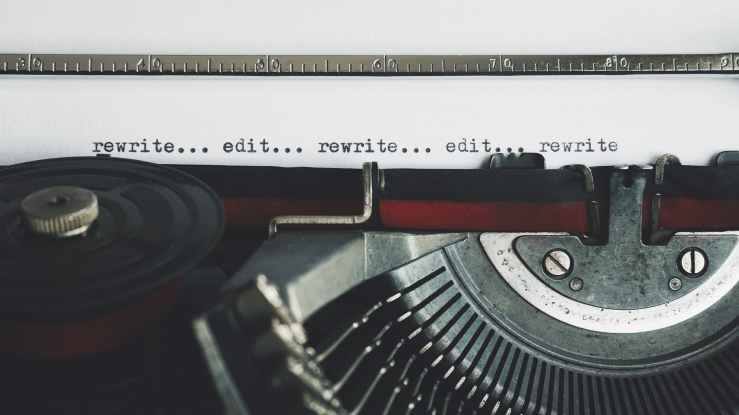
Grammar is something I’m always learning, continuing to increase my knowledge of. When I write the first draft of a story, I won’t even think about grammatical errors, punctuation, spelling, etc. The first draft is just getting the ideas down on paper (or the computer) in its unencumbered form. But when I start to edit, I’ll start to question if the way I wrote something is correct. Even if it might read correct, it won’t sound correct when I read it aloud.
I’ll begin to look up the definition of a word to see how it’s supposed to be used. One word I always look up is “passed” and “past.” Another is “further” and “farther.” I know “passed” has to do with distance, and “past” has to do with time, but I’ve seen them used interchangeably, which only makes it more confounding (not to mention the way it’s used as an adjective, adverb, and noun).
And with the rules regarding commas and em dashes, I’ve seen them use interchangeably as well. And with semi colons and periods, some writers prefer one or the other, or both, and their usage is almost dependent on style rather than form.
It seems that some of the rules of grammar depend very much on the context of the writing, whereas others are set and stone, even though some writers could abandon them for the sake of presenting a certain style or for dramatic effect. For example, if a writer was writing in the first person, or was writing in colloquy, or in a certain dialect, etc.
The rules of grammar are not as rigid as the rules governing mathematics, since grammar is more like an art, dependent on the reader knowing the rules just as well as the writer, whereas mathematics is like a science where one mistake produces an error in which the entire sequence collapses. But there are grammatical rules nonetheless, such as the word “I,” as a noun, must be capitalized, and the first letter of a sentence, and the first letter of a name. But whereas mathematics is about precision and consistency, allowing freedom only in the problem-solving approach, the rules of grammar are more like guidelines rather than axioms or unyielding laws, since their laxity depends on what a piece of writing is about.

 Fallton Havenstonne