

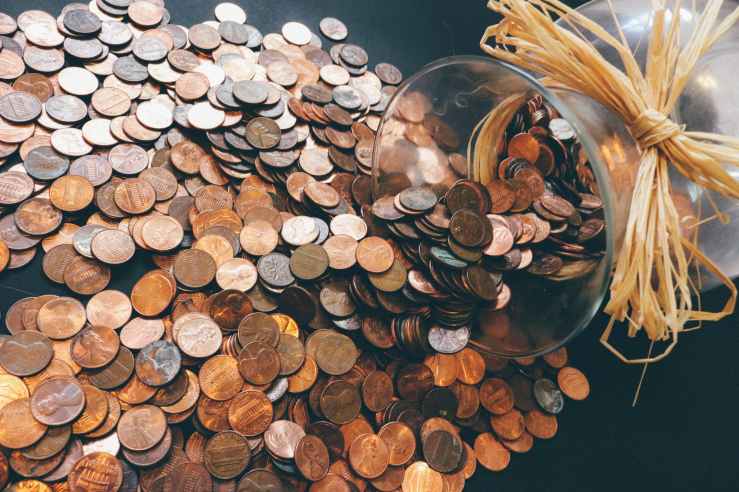
Loose change has that cumulative effect where the more of it you collect, the more it adds up. Even a small pile of loose change gives the appearance of it being more than it’s worth. A couple dozen pennies might look like twice or three times its value (from a glance, it’s not exactly the sum of its parts).
With pocket change, we don’t think much of it. We empty it out and put it somewhere like on the counter or in a drawer. But if we do this long enough, eventually that pile of grimy and toned loose change begins to look like it might be worth several dollars. It really depends on the size of the coins (i.e. nickels, quarters, half-dollars even) and how high they stack up.
Besides, loose change doesn’t seem all that important compared to a dollar bill, or the number in our bank accounts, but as the saying goes, never judge a book by its cover. I once found a dime in a chunk of change I had collected over the years, thought nothing of it until I saw it sandwiched between a stack of dimes. It stood out because under the light, the rim on it shined like the crescent of a moon. I removed it, inspected it from all sides, noticed it didn’t have any copper on it.
I looked up the date on the obverse, saw that it was a lot older than the rest of the stack. I forget exactly what the date was (maybe in the 1950s), but that’s when I learned that it contained ninety percent silver.

 Fallton Havenstonne